Showing posts with label Darrel Nelson. Show all posts

Wednesday, January 15, 2014

My Inspiration

I must confess that I’m a sucker for a good love story, and I credit my wife for my penchant for writing romantic stories. When I first met Marsha, I fell for her head-over-heels. I was incomplete at the time and didn’t know it. Afterward I felt whole, and that is the subject I like to explore in my stories—people who are incomplete finding fulfillment and wholeness in one another.

Sometimes I wonder if it might be more “manly” to write a page-turning spy thriller or a heart-stopping war saga. But when I sit down to write, love stories are what naturally come out, thanks to Marsha.

She is my biggest supporter and my toughest critic! Especially regarding my female characters’ thoughts, feelings, and actions. Sometimes Marsha laughs at my efforts, and sometimes she just rolls her eyes, but I trust her judgment implicitly and would not dare commit anything to final form without her approval. So far I have been unable to slip anything by her—I know because I keep trying. She picks me up when I get discouraged, and she keeps me grounded when I get carried away. Both of my novels are dedicated to her, as will be my third one (entitled Following Rain) when it comes out in 2015.

We’ve been married for forty years, and Marsha was then and still remains my inspiration. Thanks for the journey to date, love.

Friday, December 27, 2013

Learning to Trust


I received an interesting text the other day from a budding author who lives in my hometown. She has written a book and wanted to know how to get it published. This is not unusual because I have had a number of acquaintances ask this same question, or versions of it, over the years.

I am not comfortable dispensing here’s-how-to-get-your book-published advice until I have had a chance to look at the manuscript, if possible. So far, the ones I have proofread for others have needed revision. In some cases, a LOT of revision. I do not claim to be a good editor, but I have gained a certain amount of insight based on my own journey and know that a manuscript laden with grammatical and spelling errors, along with POV and plotting problems, will not fly.

Anyway, I texted the young author back and volunteered to proofread her manuscript before proceeding to the next step. Her reply was: I’m not comfortable sending it to you. I’m private about my work. My mother looked it over and now I need to know how to get my book published.

Her response reminded me of my own concerns about someone stealing my work or plagiarizing my story ideas. There was a time I worried a great deal about sending my manuscript off to publishers, only to find my book published under someone else’s name a year later! That never happened, of course. But I’d heard stories.

I texted the young woman with some general advice and concluded with: You are going to have to trust people at some point. Reputable agents and publishers will not steal your ideas, but authors should do their homework in advance and know as much as they can about the agency they are approaching. Checking out editors and publishers online, as well as reading testimonials and endorsements from other authors, can help budding authors avoid certain pitfalls. Having to pay money up front for publication, representation, or a review tells something about the nature of the agency.

Truly, I wish the young woman luck. But where she wouldn’t even let me—a friend and neighbor—look at her work to offer a “professional” opinion, I’m not very hopeful. At some point in her journey toward publication, she is going to have to develop trust.

Do any of you have other advice I could pass along to her?

I hope everyone had a Merry Christmas. Let me wish you a Happy New Year and the best to you and your loved ones in 2014.


Friday, December 6, 2013

Switching Horses Midstream


I really enjoyed Bruce’s article: “To Be or To Have Been—POV and Tense.” It came at a time when I was wrestling with a new novel, one in which I decided to do some experimenting. I began writing in the first person, present tense. Several noted authors write or have written in this style, so I decided to give it a go.

 Writing in the present tense is SO immediate, and it is easy to get lost in the character’s head. It is also easy to get hung up on the mundane—expressing the character’s thoughts and feelings to the point that the storyline falls by the wayside. (But what an easy way to fill the word count quota that Charisma House requires!)

Forty pages into my draft, I decided I couldn’t take it any longer. It just wasn’t working for me. Present tense is just too . . . present! I got lost inside my character’s head. Did the reader actually want to know THAT MUCH about what my main character was thinking and feeling at this precise instant?

So I spent the rest of the day converting the manuscript back to past tense. Now as I look over what I’ve written, I feel there is a better, more natural flow. And I’ve been able to climb out of my main character’s head and focus on advancing the storyline. There's nothing inherently wrong with first person, present tense. It’s just not for me as a writer.

Now regarding POV. My original draft of The Return of Cassandra Todd was written in the first person, past tense. But after consulting with my editor, I decided that my approach was too limited because I had two principle characters and wanted to give them each a personal voice. So I spent three months and rewrote the novel, switching to third person. It worked much better and I was pleased with the results.

So why is my new manuscript written in the first person when all my other published ones are in the third person? I still want to grow and challenge myself as a writer. I don’t want to always be limited to one style. Besides, the storyline for my new novel really lends itself well to the first person POV. We’ll see how it goes. Who knows? Once my editor gets a hold of it, I may be doing another three-month rewrite!

Has anyone else ever changed their mind partway through a manuscript and switched to a different POV and verb tense? Come on now, ‘fess up.

Monday, November 18, 2013

A Unique Book Club Experience


Beth’s article reminded me of a unique book club experience I had recently. It wasn’t a group signing, just one of my own. I was invited to be the guest author at a book club that consisted of a group of women who lived on local farms and ranches. The women had been meeting for many years faithfully—one of the members even kept minutes of each meeting and recorded every book they had studied.

The drive to the meeting was interesting. It took my wife and I far out into the country, along winding roads and down into a deep river valley. Cattle roamed the pastureland freely and posed a hazard, especially as the sun began to set and we realized the cattle were Black Angus!

During the drive, I thought to myself: What kind of book club experience will this be, way out in the middle of nowhere? How many will attend? Well, it turned out to be a wonderful experience, with all but one member in attendance. They were exceptionally cordial and complimentary, and even asked me to pose for pictures with them afterward. But the biggest surprise of all was as my wife and I were preparing to leave, the book club members handed me an envelope. It contained a $50 gift card.

I’ve attended several book clubs in the past, but I’ve never been given a gift before. Just the opportunity to speak to book clubs about my books was gift enough. But this kind, isolated group went the extra mile. They even invited me to come back again so they can discuss my second book. I’m going to take them up on it!

Have any of you had an unexpected experience at a book signing?

Monday, October 28, 2013

Where DO We Get Our Ideas?


I met a cousin recently who read my latest book. Being my cousin, he was very supportive and complimentary. And then he asked a question that I have been asked frequently: Where do you get your ideas?

That’s a good question. It’s one I haven’t adequately answered yet because the truth of the matter is, I’m not sure. Where DO we as writers get our ideas? Yes, we can be prompted by inspiration from God, a newspaper article, a random comment, or a hundred other sources. But how exactly does the process work of coming up with details and organizing them into something meaningful on the page? I read a comment from a world-famous author who has written sixty books and sold a gazillion copies. He said he doesn’t have a clue where his ideas come from!

My cousin was quite curious about the creative writing process, and he pumped me for information. He referred to several scenes from my book and asked where I got the ideas for them. I told him that some were based on personal experiences, but others were pulled from thin air. That’s the best answer I could give him. Creative writing is pulling ideas from thin air—inspiration, if you will—and organizing them into a logical, sequential manner.

Some days the ideas pour onto the page like water from a pressurized hose. Other days they collect like dew, slowly and imperceptibly. The fun part, however, is looking back over something I’ve written and thinking: Where did that come from? I wasn’t planning on heading in that direction. The story has taken me on a new course.

That is the aspect of writing I like the most—letting the story surprise me. I love it when that happens! Sometimes I laugh out loud at a detail that unexpectedly surfaces, and other times I get out of my chair and pace around excitedly in the realization that an unplanned detail has surfaced, opening up a whole world of new possibilities. And, of course, there are the occasions when I despair and think that I’ll never write a coherent sentence again. Sometimes the well is full; sometimes dry. And I don’t know why that is the case, either way. I only know that when the well is full, boy, my fingers can’t type fast enough to keep up with the ideas.

I’m a huge fan of the Beatles. For all the songs that Lennon and McCartney wrote, they admitted they had no idea where the music came from. They called it the “music of the spheres” because it came from “out there somewhere.” The same place story ideas come from, I suppose.

I do believe in divine assistance, but how exactly does the creative writing process work? Any thoughts?

Monday, September 30, 2013

Balancing the Business Side of Writing With the Joy of Writing


I have written several novels over the years. Some of them target young readers and others are intended for adults. But all of them, except one, were written before I ever received a publishing contract. My most recent novel—which I just completed last week—is the only one completely written under contract.

 And I noticed a difference. With my other novels, I was immersed in the joy of writing. I got up a few hours before school and wrote because I wanted to. No expectations. No timeline. The books were finished when they were finished, and they arrived in the format that I wanted them in. They didn’t have to please anyone, nor did they have to sell. Family and friends were given complimentary copies and they appreciated them.

With my latest novel, I felt the pressure of the business side of writing. It was no longer a matter of finishing the book when I got around to it. There was a deadline. It was not a matter of writing the story to satisfy my taste. There were expectations from my editor and readers. It was not a matter of simply writing a good story. There were and still are expectations for financial returns. The publisher has invested time and effort and hard, cold cash in my books, and they want a return on their investment. Suddenly it matters what other people think and how my books are selling. There’s a bottom line, and I have felt pressure to meet it. And because I haven’t been able to do so yet, the pressure has grown.

So how can authors who are under contract balance the business side of writing with the joy of writing? I would love to hear your thoughts on the matter because, frankly, I’m still trying to figure it out.

Wednesday, August 28, 2013

Sometimes You Just Have to Laugh


Last month I wrote an article entitled “Putting the ‘Motion’ in Promotion.” This month’s article is the sequel.

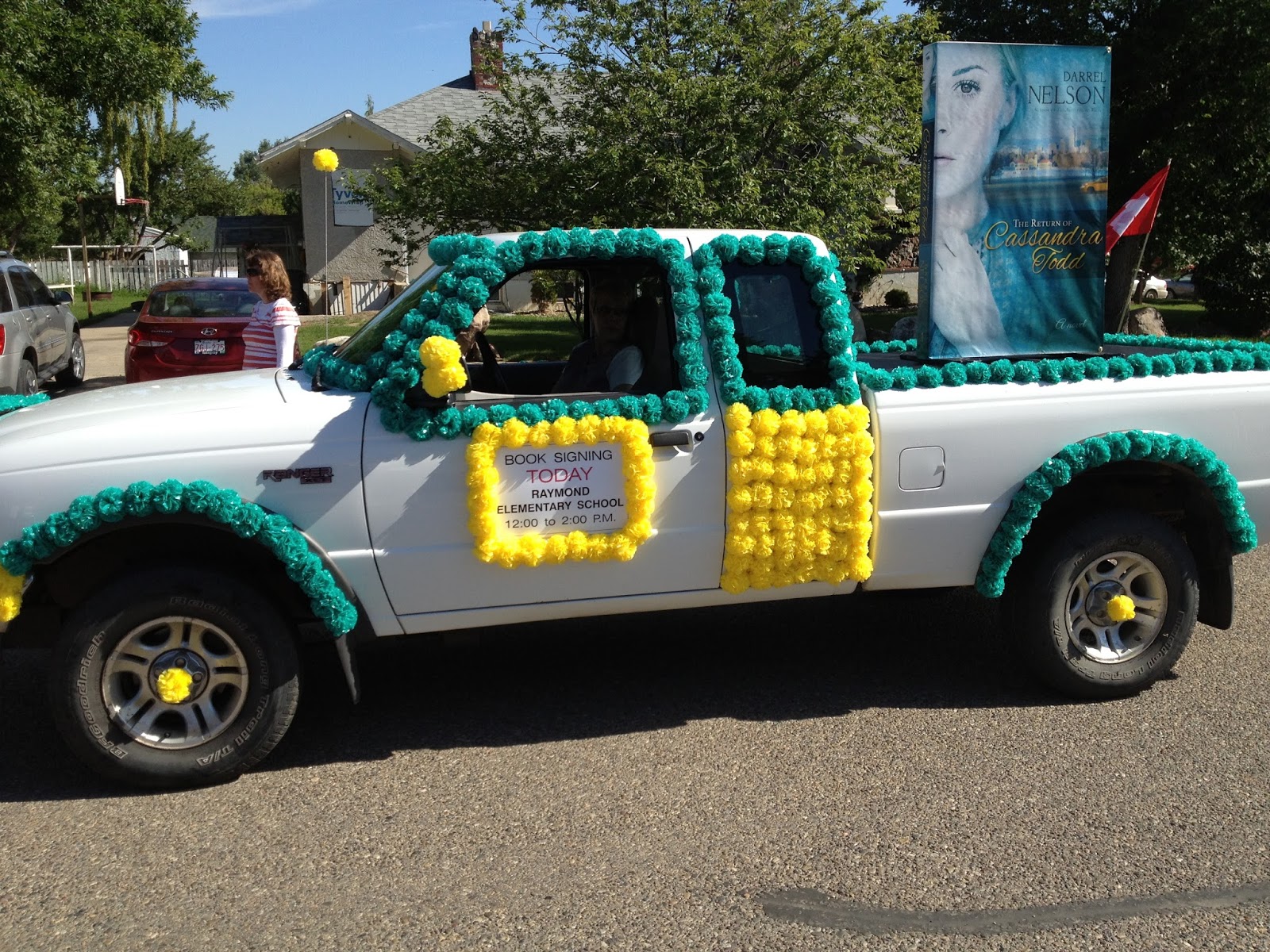
I decided to enter another local parade and advertise my books. My wife and I put 900 pom-poms on our truck, and I mounted a mock up of my two book covers on the back. I wanted to let people know that my books were available at The Cardston Book Shop, a local bookstore, so I had a sign made up to that effect. Remember, I wanted to advertise MY books and let people know that THEY were available.

As the parade got underway, imagine my surprise when people ignored the mock up of my books and focused on the sign. “Oh,” I hard many say, “it’s a sign advertising the Cardston Book Shop.” To them my book covers were merely examples of what the store carried: books! As I passed in front of the bookstore itself, the owner was sitting outside with his family, watching the parade. He called out, “Nice of you to put a float in the parade for us.”

All that work and my books were hardly noticed! But in the end, I just decided to laugh about it and hope the other authors whose works are featured in the bookstore appreciated my efforts. So you never know just how your promotional efforts are going to be received. Or perceived.

Well, one good thing. The bookstore owner is more than willing to continue carrying my books. I mean, after all, I’m his chief promoter.

Wednesday, July 31, 2013

Putting the "Motion" in Promotion

As authors, we are faced with the ongoing challenge of promoting our books. Publishers do a lot to help out, true, but the lion's share is left to us. There are a number of methods that can be used in this process, such as blog sites, reviews, interviews, book signings, and social media sites such as Facebook and Twitter.

 A method I have used, in addition to the ones mentioned above, is making a float (that features my latest book) and entering it in local parades. With the help of family members, we decorate our truck with hundreds of pom-poms. A large mock up of the front cover is mounted on the back, and signs are placed on the vehicle's doors, advertising the book signing I hold after the parade.

Throwing candy to the crowd is a local tradition. So as my wife and I drive along the parade route and wave to the cheering crowds, we toss candy to the anxious children, who have come prepared with plastic shopping bags. Invariably, the shopping bags fill to rival the bounty collected on Halloween night.

Making the float is a lot of work, and not that many people see it in comparison to the numbers that can be reached through social media. But it is a lot of fun to drive along the parade route and have people shout and applaud in encouragement. Sometimes I'll hear, "I read your book. Loved it!"

 Putting the "motion" in promotion has been a rewarding experience. But I am always looking for more ways to promote my books. Any suggestions?

Wednesday, June 26, 2013

Book Clubs


I have found that visiting book clubs as a guest author has been, in a word, fun! It's rewarding to get face-to-face feedback, and the club members have enjoyed getting a sneak peek into the book publishing industry. Invariably, the members are surprised how much work goes into taking a book from inception to completion.

My presentation is divided into two parts. In the first part I talk about the process of writing, editing, and rewriting. I show the club members the galley proofs and the changes I have made to the manuscript after the editing process is supposedly finished. For example, with my latest book (The Return of Cassandra Todd) I made changes right up to the last possible second. I tweak obsessively and finally have to stop reading the manuscript for fear of finding more changes I want to make.

In the second part of my presentation I discuss the book and invite comments and questions. One of the questions I'm often asked is this: How do you know when your manuscript is finally finished? I answer: A famous artist was once asked the same question regarding his paintings, and he replied, "I know a painting is finished when I walk away from it in boredom." I can relate to that.

 How many of you have attended book clubs as a guest author? What has worked well for you? Any suggestions?

Wednesday, May 29, 2013

How My Faith Impacts My Writing


In a recent interview I was asked this question: In what specific ways does your faith impact how you write fiction? The question gave me pause because in all honesty, I didn’t set out to be a Christian writer, per se. I set out to be a general fiction writer, hoping to appeal to as broad a spectrum of readers as possible, irrespective of religious persuasion, nationality, political affiliation, and so on. Over the years, however, I have come to realize that it’s impossible for my faith not to impact my writing, and in looking back I can see that it has been a constant influence.

So how has my faith impacted my writing? In every way! For example, I will not use inappropriate language, gratuitous sex, or graphic violence in my books. I want my children and grandchildren to be able to read and recommend them without reservation. I believe in God and His goodness, and I believe that I am accountable to Him in all I do, say, and write. So I want my books to be positive and uplifting.

But here’s the qualifier. I don’t want my writing to be “preachy.” My faith will naturally shine through, but it needs to be in a manner that’s not “in your face.” Not all of my readers are Christians, but we are all members of the human family. As such we have much more in common than our religious differences might suggest. So I paint with a wide brush and am careful not to slip in my personal doctrinal beliefs and then chuckle to think I pulled one over on my readers. I have no hidden agenda. I simply want to tell a story—shaped by my faith—that appeals to a broad base and makes my readers feel better for having spent some time with me.
 
These are my thoughts on the subject. Anyone have additional insights? I’d be curious to hear your comments.

Thursday, May 2, 2013

Feel Better--Write Better


Along with studying grammar and style tips on how to become a better writer, I found another ingredient that has helped me in the process: feeling better physically. Translation: eating more healthily, and exercising.

As part of our New Year’s Resolution, my wife—Marsha—and I joined a nice little program called Feel Great in Eight. (Eight, in this case, means eight weeks.) It’s a plan that balances the physical dimensions of becoming healthier (eating better, drinking eight glasses of water per day, exercising, getting enough sleep, etc.) with the spiritual dimensions (reading your scriptures, saying your prayers, doing service, etc.). Points are awarded for each area of activity. You total your points for each day and then add them up to get the weekly total. You submit your weekly total (first names only) to the Feel Great in Eight website, along with your weight loss. The results are posted each week and you can see how you are doing in relation to others in your group. (Again, it’s first names only, so it maintains your anonymity.)

Marsha and I liked the eight-week program so well that we signed up for a second term, which we just completed on Monday. Sixteen weeks of eating right, doing exercises, and keeping up on our spiritual activities! It’s been great!

So how does this apply to my writing? It’s simple. I feel better so I write better.

I’m not promoting this program necessarily. I’m just promoting the idea that when you feel better, you can’t but help have more energy. And when you have more energy, obviously you can do more, which includes writing too.

Anyone out there have an exercise/healthy-eating program that has worked for you?

Friday, April 5, 2013

Learning Patience...Patiently


There’s an old joke that goes: Lord, grant me patience . . . right NOW!
As a writer, I have learned something about patience over the years. It takes patience to come up with a story idea worthy of the months of labor you are going to spend on it. I’ve learned that it takes patience to develop your outline and write the first draft. It requires a great deal of patience as you send out your letters of inquiry and the rejections begin arriving, one by one. Patience is required after you finally find a publisher because an editor gets ahold of your manuscript and takes it apart and you have to patiently put it back together again. Several times! Then when the manuscript is acceptable, it still takes months for it to be printed. After that the fun part begins of promoting your book and developing a following, one contact at a time. This is the normal process of a writer learning patience.
My experience has required me to stretch even a little further. Two months after the release date of my book in the U.S., my novel is still not available in Canada! The release date was advertised as 2/5/13, which in the States is February 5. But internationally (that is, in Canada where I live) the date means May 2. And no matter how many emails I’ve sent and booksellers I’ve contacted, I can’t get the mistake corrected. So now that the initial publicity wave has come and gone south of the border, it hasn’t even begun in Canada yet. And that has been an exercise in frustration. Translation: patience.
My grandmother used to quote this old saying: Patience is a virtue, secure it if you can; seldom found in women and never found in men. I am trying to develop patience, Grandma. Honest I am. But it sure would be nice if the problem could be resolved NOW!

Tuesday, January 15, 2013

Introducing The Return of Cassandra Todd

Happy New Year, everyone. I would like to announce the February release of my new novel, The Return of Cassandra Todd. Like my debut novel it is a love story, but it is a bit of a departure. Set in modern-day Denver, The Return of Cassandra Todd addresses the issue of spousal abuse and its effects on the lives of the principal characters.

The back cover reads:

When the popular girl whose friends bullied him in high school suddenly reenters his life, little son in tow, Turner Caldwell must put the past behind him if they are to survive.

Turner Caldwell works at a local motel as a handyman while attending college full time. On his way to class one day, he is shocked to see Cassandra Todd and her young son in town. The sight of her brings back powerful memories of being bullied in high school—she was the popular head cheerleader and he the target of her friends’ mean-spirited pranks.

When Cassandra and her son check into the motel where he works and she asks for his help in eluding her abusive husband, he finds himself entangled in a dangerous drama that will require him to forgive and draw on every skill he has if they are to survive.


I was honored to have Lena Nelson Dooley write an endorsement. She said: “I loved Darrel Nelson’s debut novel, but The Return of Cassandra Todd is even better. The multilayered characters, complex relationships, and strong suspense thread kept my attention until the very last page. This one is a keeper.”

Ace Collins was kind enough to write: “This tale of suspense builds page by page as a wife and little boy must depend upon the wits and courage of the ultimate underdog to escape the wrath of a man consumed by hate born of ego and desperation. This is a book that is impossible to put down and a story that lingers long after the final page has been read.”

And Eva Marie Everson wrote: “I became riveted by the story line, the characters’ dilemmas, and the real-life dialogue. I read every free minute I had, often so fast I could hardly keep up with myself because of the heart-stopping action and emotion. In other words: I loved it! I’m a forever fan.”

I appreciate the positive endorsements and hope readers will not only enjoy the book but think about the issues addressed in the novel and be uplifted as well as entertained.

Monday, December 17, 2012

My Book Signing Experience

   I had a book signing in Denver on December 1 while my wife and I were down from Alberta, Canada, visiting our two daughters and their families who live there. My two daughters were my “campaign managers,” and they sent out invitations to their friends to attend. I arrived a little early and set up and began trying to do some “cold sales,” that is presenting my books to people in the store who didn’t know me or my book. I had no success. But then my daughter’s friends began to arrive and the sales went well. We sold all the copies in the store and then spent the evening running around Denver, buying up additional copies to satisfy the demand. We were grateful for the support.
     But the experience gave me pause. Had I gone to a store without any advance preparation or publicity, it would not have been a successful venture. Because I’m not a JK Rowling or a Stephanie Meyer, I cannot rely on mass interest and support. I attended a Stephanie Meyer book signing in Denver a couple of years back, and it was like going to a rock concert. Hundreds of screaming teenage girls queued up to get their books signed. My book signing experience was not like that! But things picked up immeasurably when my daughters’ friends began arriving. That’s why careful planning and advance publicity are so important. It’s no fun sitting at a table where store customers go out of their way to avoid you so they don’t get “drawn into” a discussion with an author they don’t know and a book they aren’t particularly interested in reading at the moment.
    What made the signing special for me was that my grandchildren who live in Denver donned their “Grandpa’s Book Buddy” T-shirts and walked around the store to help promote the event. I sure appreciated their love and support.

Monday, October 15, 2012

The Business Side to Writing

      It is a reality that the book publishing industry has a bottom line. No matter how dear a writing project is to our hearts, no matter how long and hard we have worked on our “baby,” the project must be marketable. And we as authors are under constant pressure to remain commercial, even as times and tastes and styles continue to change around us. Remaining current in an ever-changing marketplace is a daunting task.
     I have been saddened by the recent termination of contracts for a few of our friends and colleagues. It not only saddens me but frightens me as well. I’ve asked myself repeatedly: Am I headed in the right direction with my new project? Will what I’m working on right now be acceptable two years from now when it’s finally published? Have I run my course and had my “fifteen minutes of fame”? The old saying “You’re only as good as your last book” has taken on new meaning for me. In this day and age, I’m not sure how much “track record” still means.
     A friend contacted me recently and asked for advice on getting published. I told her: “You need to know your target audience. And you also need to decide on the genre that best suits that target audience. You also should ask yourself: Does my story have commercial appeal? Because like it or not, book publishing is a business, and publishers won't take on a book that they don't think they can sell. Your grandmother's diary, for example, might be special and treasured by your family, but is it something the general public will go out in droves and buy? I don't want to discourage you but book publishing is very much a business venture and your product has to be marketable or it won't be accepted. So ask yourself the basic questions I've outlined, and if you feel confident about the answers, then by all means proceed with an eye toward getting published.”
I wish my friend all the best. And I extend best wishes to those who lost contracts. My thoughts and prayers are with you.
     I hope each one of us can find fulfillment in writing and remember the singular joy that comes from putting words on a blank space where they did not exist before. The royalty check is nice . . . but fortunately that isn’t the bottom line for writers.

Friday, September 14, 2012

The Importance of Consistent Promotion

The Importance of Consistent Promotion
By Darrel Nelson and Rebeca Seitz

I was lamenting to my publicist, Rebeca Seitz of Glass Road Media and Management, the other day about the challenges of getting myself as an author known. I live in a small town in Alberta, Canada, and I still have friends and neighbors come up to me and say, “You’ve had a novel published? I didn’t know.” And that’s in my small hometown! What about people in my county, province/state, country, and continent? What about people in the world in general?
How do we as authors get the word out there about our books? Are the majority of us condemned to labor in relative obscurity?
Rebeca wrote this encouraging response that I would like to pass along. I hope it helps. She said:

Wailing raises the hair at the nape of your neck. Long, low moans produce gooseflesh along your arms. Gnashing of teeth. Pounding of keyboards. Breaking of pencils.
    Yep, it’s tough to be a writer these days.
    It’s also glorious to be a writer these days!
    As the owner of an all-service firm catering to writers of story-driven products, I hear a lot of worrying and fretting from authors. How will they break out from obscurity? With millions of books on the shelves – and more being added all the time – how will anyone know any one, specific book exists?
    Some have tried an initiative here or there. A blog tour. A media campaign. A snazzy new website. Something with Facebook. A radio blitz. They see a blip up in sales for a few days, then back to flatline. Did anything make a difference? Is there a way to truly catch the attention of the market and hold it?
    Yes.
    Yes.
    Yes.
    There is a magic bullet. A mystery known by many but practiced only by a select few authors. A piece of wisdom that, when applied, breeds contentment and – more often than not – increased sales.
    No, you do not have to call an 800 number or send me four easy payments of $19.99 to learn it. I’ll share it right now, right here, on Darrel’s blog. Ready?
    Consistent production and promotion.
    Seems too simple, doesn’t it? Way, way too easy. Just keep doing the same thing? Keep plugging away? Where’s the gusto in that? The glory? The triumph of achieving the summit?
    I’ve been in the publishing and entertainment industries a long time. Launched more authors than you can shake a stick at (it’s a Southernism, stay with me). The majority of those are now bestsellers and/or award winners.
    Please go back and read the last three words of the first sentence in the paragraph above.
    Write them down.
    Tape them to your keyboard/desk/screen.
    Those three words are why the majority of them are bestsellers and/or award winners. They stuck with it for a long time. With each book’s release, they did a bit more promotion, a tad more research for the story, a little better writing. The work of each previous title built upon itself.
    I tell authors often, “Do not determine success or failure after book one. Do not assess whether you should keep doing this when book one hits the shelf. Don’t decide if you really can secure a fan base a year after book one has been on the shelf. Don’t use book two for assessment, either. By book three’s release, you might, possibly, maybe, perhaps have enough information to decide what works and what doesn’t with regard to promoting your specific genre and writing style. Do those things for the next two books, while remaining open to new initiatives as well. By book five, you know if you should keep doing this.”
    Consistent production.
    It’s not sexy.
    Not flashy.
    Won’t make you feel all famous and special.
    But it will get the job done.
    Each book’s promotion builds on the last one. With the release of Title One, you begin to make a name for yourself by visiting book clubs, calling/visiting libraries, and posting on Facebook about the process of being published (and pestering your friends and family to death so they know you’re serious about this). With the release of Title Two, you have a bigger audience to whom you can speak. Friends of those pestered friends and family members have responded to Title One, so you let them know – along with the audience from Title One’s promo campaign – about the release of Title Two. Title Three benefits from the larger audience built by Title Two. And so on.
    By Title Five, you have a basic, solid fan base that no longer needs persuaded to buy your titles. They simply need to be informed when a new title releases. They’ll buy it if they know it exists. Now, they need to be persuaded to tell others.
    The thing a bestselling author has that a first-time author does not: a large audience who likes his/her stories and does not need to be persuaded to buy new ones or tell other people about the stories.  
    So, dear early authors reading this post, take heart. You can do this. Don’t hang everything on book one or year one. Let the pressure roll off your back. Being a successful author requires long-term approach, commitment, and perspective.
    Keep producing and promoting consistently.
    You’ll see results in the end.

Rebeca Seitz is President of Glass Road Media and Management, which provides promotion, production, and management services to storytellers. Learn more at http://GlassRoadMM.com.

Saturday, August 25, 2012

Review the Basics Continually


I had a wake up call last week that I would like to share. And I need to thank Martha Rogers and Lori Vanden Bosch for providing it.
Because I majored in English in university and have written novels, plays, articles, and songs for over thirty years, I thought I had a fairly good feel for sentence structure. What a surprise I received when Martha kindly looked over my most recent manuscript and pointed out a grammatical error I consistently made throughout the book. Lori, my editor, confirmed the error, and I had to do some fast editing to correct it.
The error involved participial phrases (or “ing” sentences as Martha describes them). For example, Tiptoeing down the hallway, she went into the bedroom. In my mind this sentence showed a transition from one place to another. First she tiptoed down the hallway and then she went into the bedroom.
Martha accurately pointed out that the sentence is chronologically impossible. You can’t tiptoe down the hallway and, at the same time, go into the bedroom. A simple fix would be to rewrite the sentence: She tiptoed down the hallway and went into the bedroom.
Lori sent me an article entitled “Participial Phrase Abuse.” I swallowed hard when I realized just how I was abusing participial phrases. The article stated:
“Participial phrases lend themselves to a host of grammatical ills, including dangling participles and chronological impossibilities. The most common problem associated with participial phrases is the dangling participle. Swimming in the ocean, the cool water refreshed him. The sentence, as written, tells us that the water is swimming in the ocean. Let’s fix it. Swimming the ocean, he felt refreshed.
“Chronological impossibilities are also common. Consider the following sentence: Walking down the hallway, he stopped to tie his shoe. Someone cannot walk down the hallway and stop to tie his shoe simultaneously, so this sentence needs revision. A possible fix: Walking down the hallway, he noticed his shoe was untied and stopped to tie it.
“When you come across one of these phrases, ask yourself two key questions: (1) Does the action expressed in the participle link up with the main clause correctly? And (2) Can these two things happen simultaneously?”
Well, that’s the grammar lesson for today. A giant thanks to Martha and Lori. I am a schoolteacher by profession, but in this area I am clearly the student—a student who had to hit the books and brush up on basic sentence structure. What did I learn? I need to be on the watch for those tricky participial phrases continually. I need to use them with care and use them sparingly. And, most of all, I need to review the basics regularly.
Perhaps we all do.  

Wednesday, July 25, 2012

It's the Small Things

Funny how seemingly small things can make such a big difference in the end.

I had spent several years writing a novel and had contacted dozens upon dozens of agents regarding representation. To no avail. Rejection slips piled up in quantities sufficient to wallpaper our living room. I decided to shelve the manuscript and chalk it up to the fact that it just wasn’t meant to be.

Shortly after this decision, my wife and I visited our son and his family, who live in in Salt Lake City, Utah. He mentioned that he had recorded a Glen Beck interview with Richard Paul Evans. My son knew I had read all of Mr. Evans’s books and would be interested in the interview.

I was.

During the interview, I was impressed by Mr. Evans’s account of the adversities he had faced in his own life and how he was working through them. No one is free from challenges, he explained. As the interview continued, a determination came over me not to give up. Not to shelve the manuscript and chalk it up to a “learning experience.” I decided right then and there to rework the manuscript once more and try again.

When I returned to our home in Alberta, Canada, I did just that. I spent six months rewriting the manuscript and trying to instill in my characters the courage and determination that inspired me that day as I watched the interview.

After completing the manuscript, I sent out another batch of letters of inquiry to agents. Within two hours, an agent contacted me to say she loved the story and wanted to sign me to a contract.
It would be nice at this point to say, “And the writer lived happily ever after.”

Turns out there was still a long way to go, however. My agent did ultimately find a publisher, but I had to do more work on the manuscript, especially once I began fine-tuning it with a skilled editor. But I was able to sustain the momentum—started when I watched the Richard Paul Evans interview—and see the project through to completion. After a journey of years, The Anniversary Waltz was finally published in May of 2012 and is receiving encouraging reviews. My second novel is scheduled to come out in the spring of 2013, and I am negotiating another two-novel contract at this time.

And to think it almost didn’t come about.

Thank you, Richard Paul Evans. If not for your interview, my manuscripts would be sitting on the shelf, collecting dust—a shelf labeled “What Might Have Been.”